
Develop and test
What?
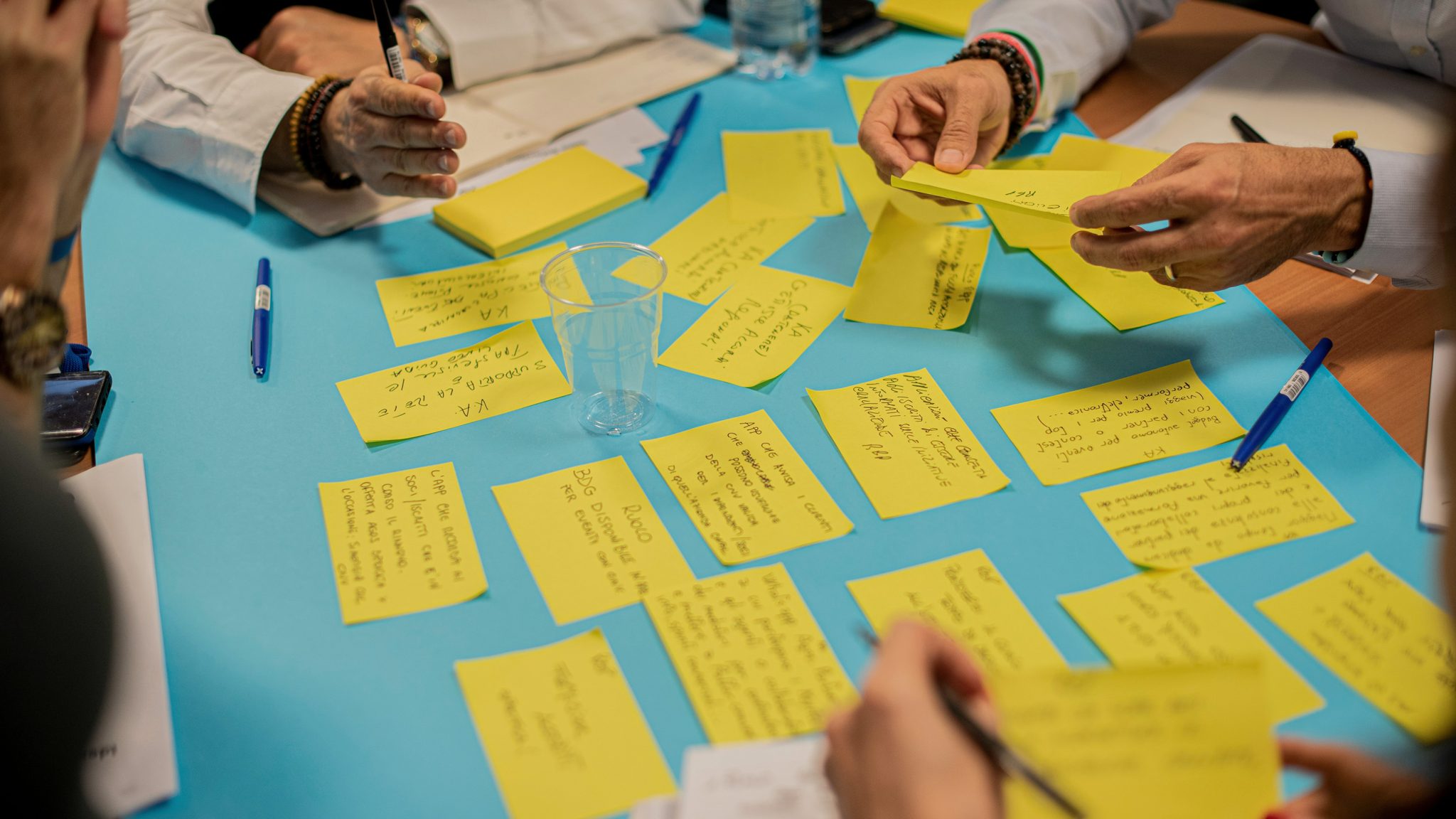
Development and testing involve generating new ideas for social change that will improve people’s living conditions, as well as designing and testing concrete solutions in collaboration with the people and social actors involved. This is where theory and practice come together. This element of the process involves shaping social innovations—how the new takes form. Social innovations can take many different forms, such as new initiatives, services, methods, meeting places, and collaborations.
Why?
Coming up with innovative solutions to complex societal challenges takes time. Innovation arises when we are allowed to experiment and explore outside established frameworks and structures. Therefore, dedicated spaces are needed where ideas and proposals can and are allowed to be developed and tested outside of standard routines and processes. To create these spaces, it is important to use methods and formats that foster creativity and open, permissive exploration. An environment that combines different logics and perspectives and helps create new approaches and angles on the problem. Spaces for jointly experimenting and trial-and-error, generating different ideas and prioritizing among them, as well as designing, prototyping, and testing possible solutions. Finally, feedback must be collected to adapt the solutions.
How?
In practical terms, there are many methods and approaches you can use if you want to develop new ideas and test them. Here are a few:
- Innovation Lab
- Design thinking
- Crowdsourcing
- Innovation competitions
- Dialogue processes
- Policy Lab and Experimental Policy
- Regulatory sandboxes
- System demonstrators
It is common for only certain voices and groups to be involved in developing proposals and solutions to societal challenges. To avoid silos and other limiting structures, it is important—regardless of the method—to work proactively and consciously design inclusive processes. Both those who are affected and those who influence and can implement the ideas should be represented, as idea development and testing benefit from breadth and diversity.
This can be achieved by ensuring that all relevant sectors of society are represented—civil society, the business community, the public sector, and academia. To ensure long-term ownership of the solution, it is important that those with the mandate and capacity to implement the solution in the long term are involved in the development and testing of solutions. It is also crucial to consciously include underrepresented actors and perspectives and to involve participants of different ages, genders, ethnicities, backgrounds, or with various disabilities.
In addition to broad representation, there must be opportunities for all stakeholders to participate and have a say in the forums that are created. For the solution to be effective, feedback is also needed from the target group and relevant stakeholders regarding whether the solutions are effective.
In this phase of the innovation process, it is common to test many different options on a smaller scale, through prototypes or pilot projects. The goal is to find the format that best suits the context and the target audience. The testing process often yields valuable insights, which in turn can lead to significant changes to the initial idea. This is something you need to be prepared for.
It’s also about finding the right format for social innovation. Is it an initiative? Or a service? Or perhaps a method, a meeting place, or a form of collaboration?
Guiding questions
- How can we develop solutions that are different from—and better than—those already established in society?
- How can we use the horizontal principles of gender equality, accessibility, and non-discrimination as a resource?
- Are solutions being designed to suit women and men of different ages, countries of origin, functional variations, and so on?
Understand societal challenge
Envisioning societal change
Mobilise
Develop and test
Realise and disseminate
Create value
The social innovation process
The social innovation process
Methods and tools
Here you’ll find a selection of methods and tools that illustrate the “Develop and Test” element. Some of them are also excellent tools to use in your innovation process. They have been selected because they work in various contexts and in different parts of the world. Many of them promote innovative thinking, shifts in perspective, inclusion, and co-creation.
Please let us know if you have any other suggestions that you think might work!

Lego Serious Play
Lego’s Serious Play began as an experience-based process designed for use in guided workshops with adults to promote dialogue and encourage reflection, as well as to develop problem-solving skills and the use of imagination. However, the Serious Play starter sets are also suitable for fostering critical thinking in children ages 6 and up. Each set is designed to improve various skills, such as reflection and dialogue. This innovative approach to interaction is a valuable asset in both the business world and education, helping participants open up through the accessible medium of play.
Example
Here we compile examples of social innovations that, in collaboration with affected individuals and community stakeholders, develop new ideas for social change and test concrete solutions.

Read, listen, and watch
The tips below have been selected to deepen your understanding of the “Develop and Test” element. They are intended to provide practical guidance for designing and implementing innovative initiatives. Hopefully, these tips can also serve as a lens through which to reflect on “how we’ve always done things,” paving the way for further social innovations.
Most of the tips are freely available via the links provided.


Video
TEDx with Alan Budge on participatory budgeting
Participatory budgeting can be implemented on both a small and large scale. It is an inclusive process that makes it possible to move from an idea to concrete action. The process begins with the collection of ideas, which are then organized and assessed for feasibility before being put to a vote. The proposals that receive the most votes are funded and implemented, often with the proposer actively involved. The method originated in Brazil, where it was developed to reduce corruption and strengthen citizen participation, and has since spread globally; it has been used in New York, among other places.
