Understand societal challenge
What?
This element focuses on understanding a current societal challenge, its causes and effects, from various perspectives. It involves identifying and analyzing needs and societal challenges through dialogue between relevant target groups and societal actors. A societal challenge can stem either from a thematic area (e.g., poor health or segregation) or a geographic area (e.g., a neighborhood or a park).
The key here is to identify the causes and consequences of the problem! How can needs, causes, and consequences be understood from different perspectives? Who is affected by the problem or societal challenge? Does the challenge look different for women and men of different ages, countries of origin, and functional abilities? Which stakeholders have the mandate and resources to bring about change?
Why?
In social innovation, it is important to foster a broad understanding of societal challenges by drawing on diverse perspectives, fields of expertise, and sectors of society. To bring about positive change in society and find innovative solutions to complex societal challenges, the problem and the needs must be identified and analyzed from various perspectives.
If societal challenges are complex, we need a collective understanding of them. We need to understand how different actors, their interactions or lack thereof, resources, norms, and rules, cause something to not function as it should. Different actors see different needs and possess different knowledge. Different actors also have different mandates and resources. It is also important to involve the people and organizations directly affected by the societal challenge.
This element is also important for organizations to understand their own role and the scope of their action. The relevant target groups and stakeholders need to gain a deeper understanding of the societal challenge, examine the problem from various angles, and break it down into smaller components.
How?
It is beneficial for the group tasked with identifying and analyzing the need to be diverse, so that it incorporates as many perspectives as possible, but also includes stakeholders who have the authority and resources to influence and bring about change. Individuals, organizations, and stakeholders who can help find solutions to the problem.
Take into account different sectors, industries, professional roles, and fields of expertise, and include a diverse range of individuals and organizations based on gender equality, accessibility, and non-discrimination.
It is also important that the relevant target groups and societal actors affected by the societal challenge or problem are invited to participate in the social innovation process. Start with the needs of the target groups, but also consider the situation at the systemic level, taking a holistic perspective.
Think outside the box!
Make plenty of room for questions.
Guiding questions
- What data is used to identify and analyze the societal challenge?
- How can our understanding of societal challenges be developed in collaboration with target groups and other stakeholders?
- Does this understanding of the societal challenge differ from other established or alternative understandings?
- Are the horizontal principles of gender equality, accessibility, and non-discrimination used to understand the societal challenge?
Understand societal challenge
Envisioning societal change
Mobilise
Develop and test
Realise and disseminate
Create value
The social innovation process
The social innovation process
Methods and tools
Here you will find a selection of methods and tools that illustrate the element “Understanding the societal challenge.” They have been chosen because they are effective in various contexts and locations. Many of them promote innovative thinking, shifts in perspective, inclusion, and co-creation.
Please let us know if you have any other suggestions that you think might work!

Problem tree
A problem tree is an analytical tool used to identify and understand the root causes of a problem and its consequences. It helps visualize how different aspects of a problem are interconnected and can be used to identify potential avenues for change. The tool can be used to analyze, map out, and deepen understanding of a problem, its causes, and its consequences. Furthermore, it can serve as a basis for planning strategies on how to tackle the problem. The problem tree can facilitate joint discussions and consensus. It is a well-known tool used by many to map out problems.
Open space
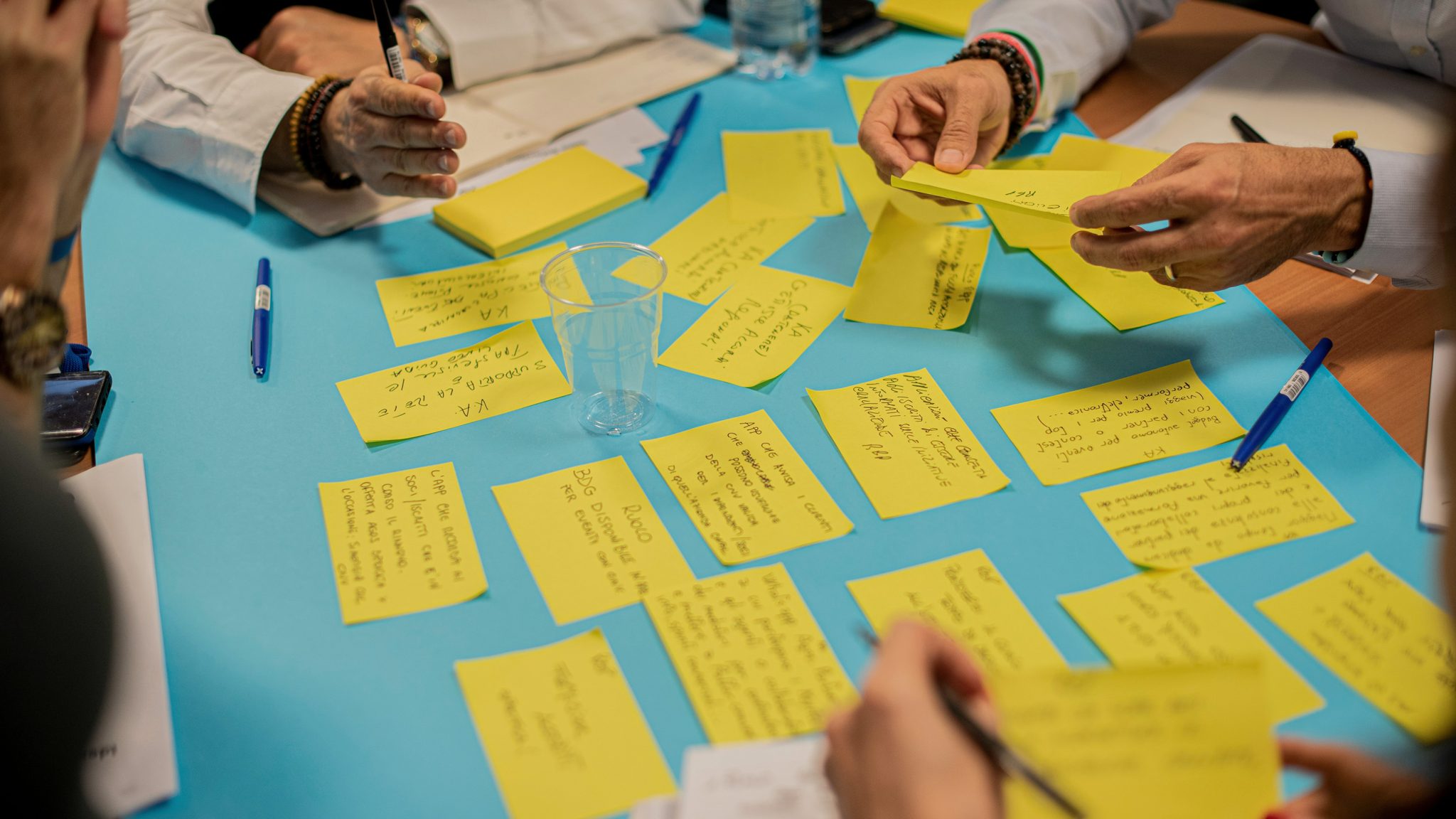
Open Space is a method for dialogue, sharing experiences, and development work that allows all participants to have their say. The method is flexible and can be used for both small and large groups, ranging from 5 to 1,000 participants. An Open Space session can last from a few hours to several days and can be conducted with careful planning or spontaneously during a training or conference day.
Example
Here, we have gathered inspiring examples of social innovations that, in various ways, help identify, analyze, and understand complex societal challenges.

Read, listen, watch
The tips below have been selected to deepen your understanding of the element “Understanding the Social Challenge.” They are intended to provide practical guidance for designing and implementing innovative initiatives. Hopefully, these tips can also serve as a lens through which to reflect on “how we’ve always done things,” paving the way for further social innovations.
Most of the tips are freely available via the links provided.