
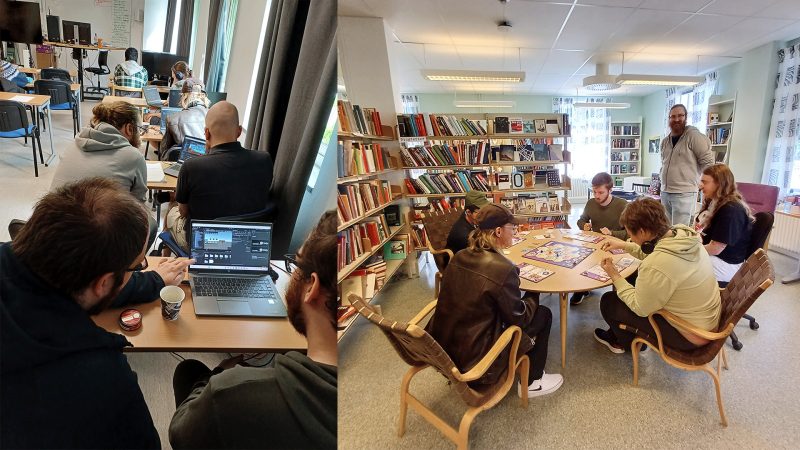
Game Camp is a course in game development designed to motivate students, run by the social enterprise Fördomsfritt CV Sverige (FCV Sverige). The course aims to help young adults aged 18–29 (16–29 in a pilot course in 2025) who are neither working nor studying to find motivation and receive guidance through game-based learning. This social innovation combines a structured and engaging environment—with a strong focus on highlighting the individual’s abilities—with opportunities for participants to develop games themselves and take part in various activities within positive contexts. Game development is used here as a driver for learning, collaboration, and personal development. Academic and career guidance is part of the program, and connections are made to the video game industry and other interesting career fields for the individual. The Game Camp course has helped many young people break out of their isolation, feel better, and take steps toward education and entry into the labor market.
What is social innovation?
What makes Game Camp socially innovative is its combination of game-based learning with a supportive and inclusive environment, as well as its connection to academic and career guidance. Another aspect of its social innovation is a groundbreaking collaboration with FCV’s network within the gaming industry (such as game studios and industry role models).
The course runs for eight weeks, and participants learn the basics of game development, including game design, graphics, and programming. The course includes both theoretical and practical components, during which participants develop their own game projects. By combining game-based learning with academic and career guidance related to game development, Game Camp creates an inclusive and motivating environment for participants.
The supportive and inclusive environment surrounding the participants is a key factor and is built on many different elements. For example, highlighting the skills each individual brings to the course and uses in the games, such as communication, collaboration, and language skills.
Other aspects include creating fun activities, giving positive feedback, and letting them know they’re missed when they’re away. Everything is centered on the individual. Game-based learning makes the activities fun and meaningful.
The course is based on the "Youth for Youth" model, in which participants support and empower one another through participation, mutual support, and shared experiences. Within FCV, young people have the opportunity to try out educational roles through a special onboarding model, which strengthens their sense of responsibility, participation, and self-confidence. The method is crucial for creating a sense of security, motivation, and a sense of belonging, according to the founder of FCV Sweden.
Game Camp ambassadors from the industry lead inspirational sessions, providing participants with valuable insights, broader perspectives, and the motivation to explore and learn about different career paths and opportunities in the gaming and tech industries.
What is the societal challenge?
Game Camp addresses the challenge posed by young adults who are staying at home and struggling to find the motivation to move on to further education or work. Some may also be dealing with mental health issues. According to the founder of FCV Sweden, several municipalities struggle to reach this target group, a significant portion of whom are 20 years of age and older. Since a large proportion of them are at risk of long-term social exclusion, there is a great need for intervention, but outreach efforts specifically targeting this group (over 20 years of age) remain limited in many municipalities.
What does the vision for social change look like?
Game Camp’s vision is to create a future where all young adults, regardless of background, have the opportunity to participate in and contribute to society. By providing a structured and engaging environment, we can help break the cycle of social isolation and foster new motivation to pursue education, enter the job market, and, above all, build participants’ self-confidence.
Which stakeholders and resources have been mobilised?
FCV collaborates with folk high schools and municipalities, including Kramfors and Hola Folk High School. They also receive support from other funders and partners, such as the Kramfors Coordination Association. These partners bring experience and a commitment to supporting young adults who are socially excluded.
Young people themselves have been heavily involved in the development of Game Camp. Among other things, 300 young adults and high school students—including game design students and those in vocational training programs—tested FCV Sweden’s in-house career guidance game, Hot Skills. This educational tool has been used in every Game Camp.
What does the development and testing process look like?
The founder and CEO of FCV Sweden, which developed Game Camp, previously worked at the Swedish Public Employment Service and as an educational and career counselor, and has an interest in both gaming and the target group’s situation. Previous positive experiences with game-based learning and a deep frustration that the Swedish Public Employment Service’s labor market initiatives did not meet the needs of young people provided the ideas and inspiration to develop the Game Camp course. Niche, complementary initiatives were needed, according to the founder.
The course was piloted in 2020–2021 in collaboration with the Municipality of Boden under the name Andra Vägar. The concept was then developed into a game camp (called “Summer Camp 2021”). According to FCV Sweden, the results were very positive, with 90% of participants going on to further education. They continued to refine the program and have conducted the course six times since 2021. The founder/CEO states that a full 97% now proceed directly to further education. A very small number move on to other forms of employment.
The course has been continuously tested and improved based on participant feedback and experiences from previous courses. To make it easier for participants to get started with game development, a new tool was developed this year: the FCV Engine. It is a starter kit for the Unity game engine that includes pre-made components and simple step-by-step guides. Created within the framework of the Youth for Youth model, it enables even beginners to quickly build, for example, their own game level—without needing any prior programming knowledge. FCV Engine is an example of how the course continues to evolve to meet participants’ needs, provide feedback, and lower the barriers to learning.
How have these innovative solutions been implemented and disseminated?
Game Camp has evolved into a well-established initiative aimed at reducing youth in-activity, boosting self-confidence, and improving future prospects for young adults. The program has secured long-term support through partnership agreements with municipalities and regional stakeholders. A pilot project is currently being planned to integrate the course structure into the IM program with the goal of increasing school attendance. This initiative is based on experiences where participants with previously negative school backgrounds have demonstrated high attendance during Game Camp.
FCV is actively working to expand the method to more locations and target groups. A pilot project using a Game Camp toolkit is currently underway. It is being tested during this year’s program to eventually make it easier for adult education providers to run the course themselves as part of their regular offerings once FCV is phased out—with FCV stepping in to provide guidance or other support as needed. The toolkit will be evaluated during the year and may in the future be offered as a licensed solution to ensure quality and the long-term dissemination of the method.
Today, Game Camp is based in Kramfors, with the ambition of expanding nationwide, and discussions are underway to make this possible. One vision is to gain greater attention at the political level to facilitate broader and faster scaling, according to the founder of FCV. FCV also sees opportunities to offer the course digitally, supplemented by local mentors with an interest in gaming and access to personalized academic and career guidance.
What value has been created?
Since its launch in 2021, Game Camp has provided participants with significant benefits, according to the partners’ own data. For example, figures from Hola Folk High School in Kramfors show that as many as 97% of participants from 2022 to 2024 went on to pursue further education or other employment after participating in Game Camp.
Participants are also given the opportunity to meet like-minded people and boost their self-esteem, which may have been low after spending many years alone at home. The FCV representative explains that even romance can blossom at these game camps. The participants have been lonely and isolated for so long. The program has helped them broaden their perspective and see more opportunities. The same representative also states that 100% of participants recommend the initiative to others in a similar situation. Thus, the target group—young people—attests that this social innovation leads to better living conditions.
There are also significant economic benefits associated with initiatives such as Game Camp. Calculations based on KAMSO—a calculation tool for initiatives addressing social vulnerability, developed and managed by Umeå University with funding from Skandia’s Idéer för livet foundation—show that it is sufficient for just one person to go on to pursue higher education for the initiative to be socio-economically justifiable, according to the founder of FCV. FCV plans to conduct further socio-economic analyses using KAMSO to further highlight the value of the course.
At the same time, surveys conducted by the Coordination Association during the 2022–2024 period have shown positive changes at the individual level, including improved health, increased well-being, and greater optimism about the future among participants, according to the founder of FCV. Discussions are also underway with RISE regarding potential follow-up research to evaluate the long-term effects of Game Camp.