
Innovative Solutions for an Inclusive Workplace in 2024
On October 23, 2024, we organized the second edition of the conference “Innovative Solutions for an Inclusive Workplace” at Kulturens hus in Luleå, in collaboration with the National Network for Coordination Associations (NNS) and the Partnership for Social Innovation.
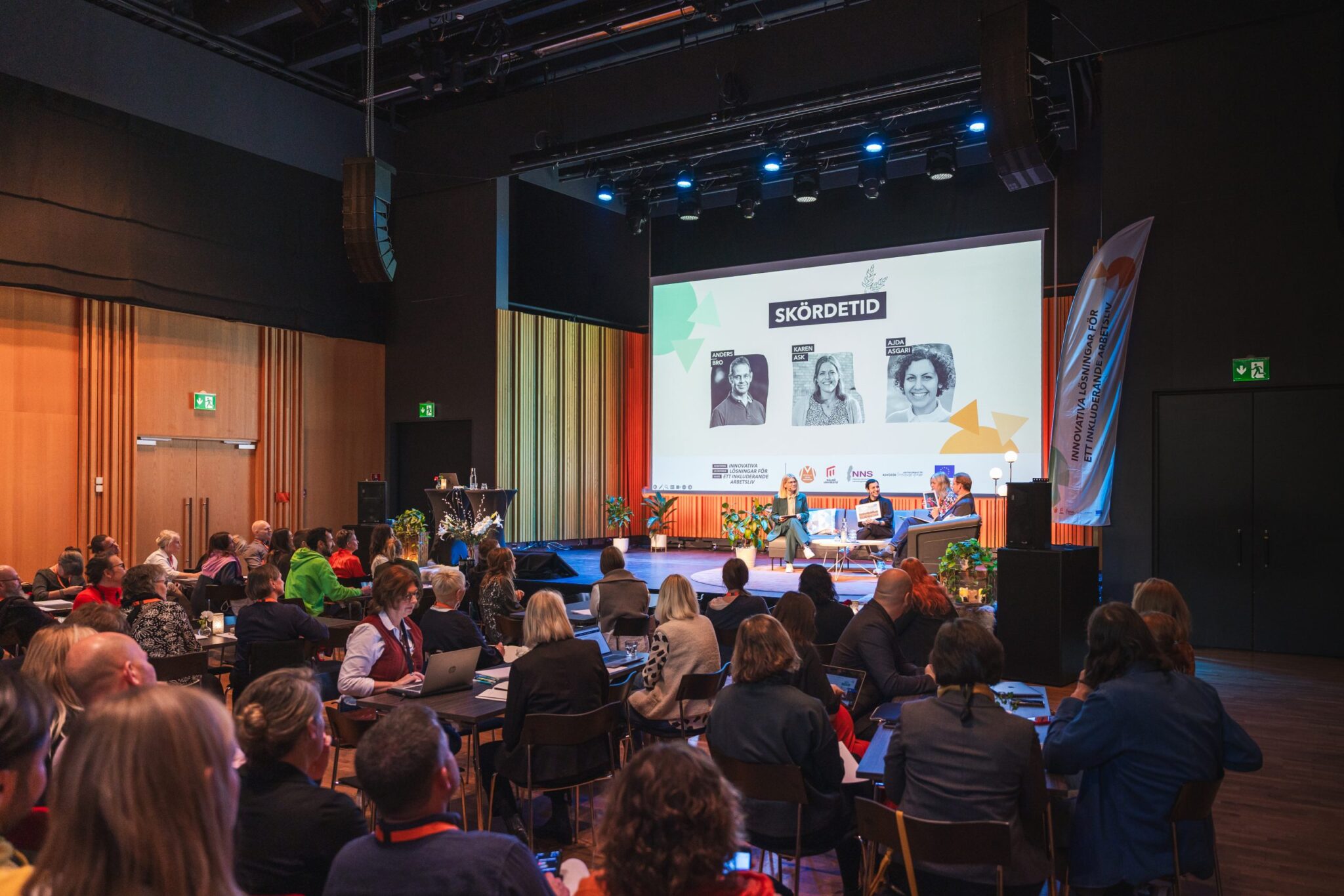
Over the course of a full day, we delved into questions such as:
Voices from the conference
We took the opportunity to interview four of the conference participants to hear a variety of perspectives and examples of which groups we need to do a better job of including in the Swedish workforce, and what radical changes are needed to create an inclusive workplace.
See our interviews with Ajda Asgari, Anna Åström, Birgitta Nyström, and John Brauer below.
Program
10:00–10:10 a.m. Hello and welcome!
Head moderator Malin Winberg and the organizers opened the event and welcomed everyone to the conference and to Luleå.
9:00–9:10 a.m. / Hello and welcome
10:15–11:00 / Keynote / Moral Imagination for Radical Societal Shifts with Phoebe Tickell
Phoebe Tickell, researcher, activist, and CEO of Moral Imaginations, takes us on a journey exploring how we can view learning, the world, and the future. How can we open up our moral imagination to radical social change? This theme will serve as a common thread throughout the conference and the day.
11:00–11:30 Break & Coffee Break
11:30–12:40 Breakout sessions
1. What can we learn about social innovation from the European Social Fund?
This session explored the lessons that can be drawn regarding social innovation from European Social Fund (ESF) projects and programs. Among other things, the discussion focused on the types of innovation in the workplace and broader society that are being pursued in projects funded under the ESF’s social innovation program area. We also discussed what kind of innovation is possible within the framework of ESF programs and other factors in organizations and society. The discussion was based on preliminary results from the annual analysis report of Sweden’s national Competence Centre for Social Innovation the ESF.
Moderator:
Malin Lindberg, visiting professor of social innovation at Malmö University
Participants:
- Johnny Karlsson, National Coordinator, Swedish ESF Council
- Lena Lago, Vice Chair of Skoopi
- Anna Tengqvist, National and International Coordinator, Forum for Social Innovation Sweden, at Malmö University
View the presentation from the session (PDF)
Reflector:
Karl Johan Bonnedahl, Associate Professor of Business Administration, Umeå University
Observer:
Anders Bro, Development Manager: Social Economy, Partnership for Social Innovation in Örebro County
3. What societal challenges do we need to focus on in order to create an inclusive workplace?
What societal challengesare critical toaddressinorder tocreate a more inclusivelabor marketand workplaces?In this session,participants conducted a joint analysis of current patterns and trends that warrant attention. The analysis was based on input from stakeholderswhoworkdailyto increase the inclusionofpeople who arefar fromthe labor market.Participants in the sessionalso hadthe opportunityto sharetheir insightsandexperiencesin this area. The resultsof the session willbe incorporated intotheSwedishESF Council’s market intelligence efforts ahead ofupcoming calls for proposals intheEuropeanSocial Fund’sprogram areaforsocial innovation.
Moderator:
- Mattias Bergström, Executive Director of the Central Östergötland Coordination Association and National Coordinator for the National Network of Coordination Associations (NNS).
- Anna Lexelius, Executive Director of the Östra Södertörn Coordination Association and National Coordinator for the National Network of Coordination Associations (NNS).
Participants:
- Anna Tengqvist, National and International Coordinator, Forum for Social Innovation Sweden, at Malmö University
- Emma Sterky, former Executive Secretary of the National Coordinator for Agenda 2030 Inquiry
- Kristin Bergwall, Executive Director, Coompanion Norrbotten
- Conny Göterfors, National Coordinator, Swedish ESF Council
Watch a video messagefrom Karin Ekdahl Wästberg, Director of Innovation, City of Stockholm
Watch a video messagefrom Åsa Eriksson, Member of Parliament, Social Democratic Party
Reviewer:Lena Abrahamsson, ProfessorofIndustrial Engineering and ManagementatLuleåUniversityof Technology
Observer: Ajda Asgari, Vice Chair, National Network for Coordination Associations (NNS)
2. How can our innovative ideas create value for more people?
In this session, you were introduced to Sunderby Folkhögskola and the “DC-Farming” project, which aims to foster partnerships between data centers and social enterprises that promote employment. DC-Farming utilizes surplus energy to grow fruits and vegetables in greenhouses, while creating job opportunities for people who are far from the labor market.
We used DC-Farming as a case study to explore how we can improve our ability to explain the value of our innovations, present it in a simple way, and make it accessible to a wider audience.
This session did not provide any ready-made answers; rather, our goal was to expand our collective knowledge based on the participants’ experience and expertise.
Moderator:
Tom Roodro, Project Manager, Forum for Social Innovation Sweden
Participants:
- Catharina Ljungcrantz, Sunderby Folk High School
- Mattias Vesterlund, research program director at the RISE ICE data center in Luleå, and adjunct professor in Energy Technology at Luleå University of Technology
View the presentation from the session (PDF).
Reflector:
John Brauer, social worker, assistant professor, and Ph.D. at Örebro University
Observer:
Karen Ask,Senior Consultant,VæksthusetsKompetencecenter
12:45–1:45 p.m. Lunch
1:45–2:20 p.m. Harvest time!
What have we experienced, discussed, heard, and learned so far today? Our observers—our “flies on the wall” and farmers—sum up the day and share their reflections and thoughts with us.
Moderator:
Malin Winberg
Observers:
- Anders Bro, Development Manager: Social Economy, Partnership for Social Innovation in Örebro County
- Karen Ask, Senior Consultant, Væksthusets
- Ajda Asgari, Vice Chair, National Network of Coordination Associations (NNS)
2:30–3:45 p.m. Parallel sessions
1. Current research on innovative workplace inclusion
This sessionfeatured presentations on current research intoinnovative workplace inclusion by researchers from various universities and disciplines.
JohnBrauer, assistant professor of social work at Örebro University, presented his research on municipal initiatives to help people enter the labor market.Charlotte PeterssonTroije, PhD in Work and Social Life Studies atMalmö University, presented her research on the potential of working outdoors for an innovative and sustainable working life. Maria Wolmesjö, professor of social work at the University of Borås, presented her research on innovative solutions for increased inclusion in working life and welfare.Participants were also given the opportunity todiscusshowthis researchrelates to theirownorganizations andtoworking lifeingeneral.
Moderator:
Gloria-Karin López, Project Manager, Forum for Social Innovation Sweden
Malin Lindberg, Visiting Professor of Social Innovation at Malmö University.
Participants:
- Maria Wolmesjö, University of Borås.See Maria’s presentation (PDF).
- John Brauer, Örebro University.View John’s presentation here (PDF).
- Charlotte Petersson Troije, Mälardalen University and Malmö University.View Charlotte’s presentation here (PDF).
Reflector:
Malin Lindberg, visiting professor of social innovation at Malmö University.
Observer:
AzamatAziSalakhov, socialentrepreneur, Drevet
3. How can we make audience engagement meaningful?
This workshop presented how Nya Kompisbyrån has worked with target group involvement (MI) in recent years. Together with Olivera and Eman, who have both participated in two different projects, experiences and perspectives were shared with a particular focus on the work with the expert group in Uppsala Yrkesmentor. During the workshop, we reflected on lessons learned and challenges, such as building trust and ensuring that all voices are heard. The presentation was followed by a discussion of a model for “co-creation” and concluded with small-group discussions where participants had the opportunity to share ideas and insights on how work with target group involvement can be improved and developed in the future.
Moderator:
Thomas Lidén, provides project support at Competence Centre for Social Innovation
Participants:
- Matilda Hardmeier, Project Manager at Nya Kompisbyrån
- Eman Mohisen, member of the expert group at Nya Kompisbyrån
- Olivera Miladinovic, intern at Nya Kompisbyrån
View the presentation from the session (PDF).
Speaker:Johanna Lindberg, Ph.D. candidate and project manager for digital transformation, Luleå University of Technology
Observer:Ylva Löwenborg, regional director at Save the Children North and chair of Samforma and Amnesty International Sweden
2. How we can foster social innovation at the local level
In this session, participants heard examples from Swedish municipalities where stakeholders from various sectors of society work together to identify societal challenges and co-create innovative solutions. They described how they go about to address societal challenges locally and strengthen their local capacity to identify and address these challenges. The session also featured a presentation of an upcoming ESF call for proposals on local initiatives related to social innovation for an inclusive workforce.
Moderator:
Joel Veborg, Project Manager, Forum for Social Innovation Sweden
Participants:
Helena Andersson Tsiamanis, Eskilstuna Municipality
Farzan Mozaffari, Right by me
Agnes Thunell, Reach for Change
Anna Tengqvist, National and International Coordinator, Forum for Social Innovation Sweden, at Malmö University
Johnny Karlsson, National Coordinator, Swedish ESF Council
Conny Göterfors, National Coordinator, Swedish ESF Council
Reviewer:
Anna-Karin Lindqvist, Associate Professor of Physical Therapy, Luleå University of Technology
Observer:
Anna Sandström Emmelin,development strategist specializing in sustainable urban development, Umeå Municipality
Session materials:
The reportRegional Collaboration on Societal Challenges – A Survey of Examples of Long-Term Organization (2024),read the report.
3:45–4:15 PM / Break & refreshments
4:15–4:50 p.m. / Harvest Time
What have we experienced, discussed, listened to, and learned this afternoon? Our observers—our “flies on the wall” and farmers—sum up the day and share their reflections and thoughts with us.
Moderator:
Malin Winberg
Observers:
Azamat Azi Salakhov, social entrepreneur, Drevet
Anna Sandström Emmelin, development strategist specializing in sustainable urban development, Umeå Municipality
Ylva Löwenborg, regional director at Save the Children North, and chair of Amnesty International Sweden