About twenty researchers gathered when Umeå University, in collaboration with Forum for Social Innovation Sweden a discussion on Science Shops and social innovation—a way to strengthen collaboration between civil society organizations and the research community.
The event was organized by Anna Sandström Emmelin from the Office of External Relations at Umeå University, together with doctoral students Maxim Vlasov from the School of Business and Aditya Pawar from the School of Design.
Why did you organize this meeting?
– Society faces complex challenges that require us to collaborate across sectoral boundaries, remain open-minded, and consider how we can work together in various ways. The Office of External Relations works to support collaboration between the university and the surrounding community and is therefore always exploring ways to facilitate this. This past spring, we co-organized the Social Innovation in the North conference and also hosted a researcher network meeting in collaboration with Forum for Social Innovation Sweden. We began discussing Science Shops and became curious to learn more about them and see if this might be something we could try out.
The Umeå Initiative is part of Forum for Social Innovation Sweden national network for researchers interested in social innovation and social entrepreneurship. Researchers from both Umeå and Luleå were invited to participate in this meeting, and a seminar open to the public was also organized. Jens Sjölander from Forum for Social Innovation Sweden to discuss the work on Pop Up Science Shops within the framework of the project Social Innovation Skåne.
A view from Denmark
Jens Dorland and Michael Søgaard Jørgensen from Aalborg University also attended the Umeå meeting. Jens Dorland’s dissertation focuses on transformative social innovation where, as part of the international research project TRANSIT, he is studying, among other things, experiences of Science Shops in various parts of Europe. His advisor, Michael Søgaard Jørgensen, is a researcher specializing in topics such as the circular economy and sustainable development; in the mid-1980s, he launched Denmark’s first Science Shop at the Technical University of Denmark (DTU). Michael describes how Science Shops began in the 1970s as an initiative in the Netherlands, in response to the needs of society and, in particular, civil society (NGOs) for research-based knowledge.
Civil society’s motivations varied but generally centered on the organizations’ need for research, with the aim of driving social change. Michael explains that, surprisingly, there had been no Swedish examples prior to the Pop Up Science Shop, which was recently organized as part of Social Innovation Skåne. Science Shops, says Michael, should be based on the open-door principle, making it easy for civil society actors to enter academia and for researchers to reach out to civil society organizations. Universities, he says, have much to gain from organizing Science Shops, such as pedagogical development, the promotion of students’ practical skills, and the development of new research questions and projects.
Jens Dorland then takes over and shares the results of his research. Using examples from his research, he describes various ways in which Science Shops are organized and funded, with the most common operational models being as part of a university or as a non-profit organization (NGO). There are also examples of Science Shops that are entirely run by students, or as a collaboration between several universities. It is also possible to launch a virtual shop. Various funding options exist, ranging from full or partial university funding to varying degrees of reliance on external funding. Jens says that a Science Shop can be run from a permanent or temporary location (Pop Up), and to varying degrees driven by demand from external needs (demand-driven) and the researchers’ own interests (supply-driven). A Science Shop can also play different roles, ranging from a more knowledge-disseminating role to a more active and impact-oriented role.
Forum for Social Innovation Sweden Science Shops
Jens Sjölander from Forum for Social Innovation Sweden insights from the Pop-Up Science Shops organized this spring as part of the Social Innovation Skåne project. In Skåne, they are called “Pop-Up” because the concept in Skåne did not have a permanent location, but instead, so to speak, opened the research shop temporarily at various locations. In Skåne, Science Shops have also been organized not only with civil society organizations, but also with small and medium-sized enterprises. The experiences have been positive, and discussions are now underway regarding the possibility of developing a more permanent form of Science Shops in Skåne at Malmö University. In 2018, Malmö University will become a university, and increased focus will then be directed toward research that addresses societal challenges in various ways—an orientation that aligns well with the underlying philosophy of Science Shops. Science Shops also fit well with Malmö University’s focus on challenge-based learning, with the goal of promoting sustainable learning and development and strengthening students’ ability to act as agents of change.
The future, opportunities, and challenges.
The day concluded with small-group discussions in which the researchers explored the possibilities of establishing a Science Shop in Umeå, how it would be organized and funded, and what challenges they anticipated. The discussion highlighted positive comments about the opportunity to work more with real-world cases in educational programs with the support of a Science Shop, but questions were also raised about what a Science Shop actually was and how it differed from other established approaches, such as Living Labs.
What are your thoughts on today, and what will be your next step, Anna Sandström Emmelin?
– It was interesting to learn more about what a Science Shop can be and how it can take many different forms. We also had fruitful discussions that we will continue to explore to see which aspects of this we could test in Umeå. One possible next step could be to expand our work so that students can solve societal challenges posed by external stakeholders as part of their education, ideally linked to the Sustainable Development Goals. There are many points of overlap with activities we’re already working on through educational partnerships and platforms like AIMday. There will also be an opportunity to continue the discussions during, among other events, the Social Innovation in the North conference that we are organizing in Umeå on April 25, where we will highlight good examples of social innovations from Västerbotten and Norrbotten.
In Malmö, the discussions continue, most recently during Social Innovation Summit as well as the researchers' meeting organized in conjunction with the Summit.
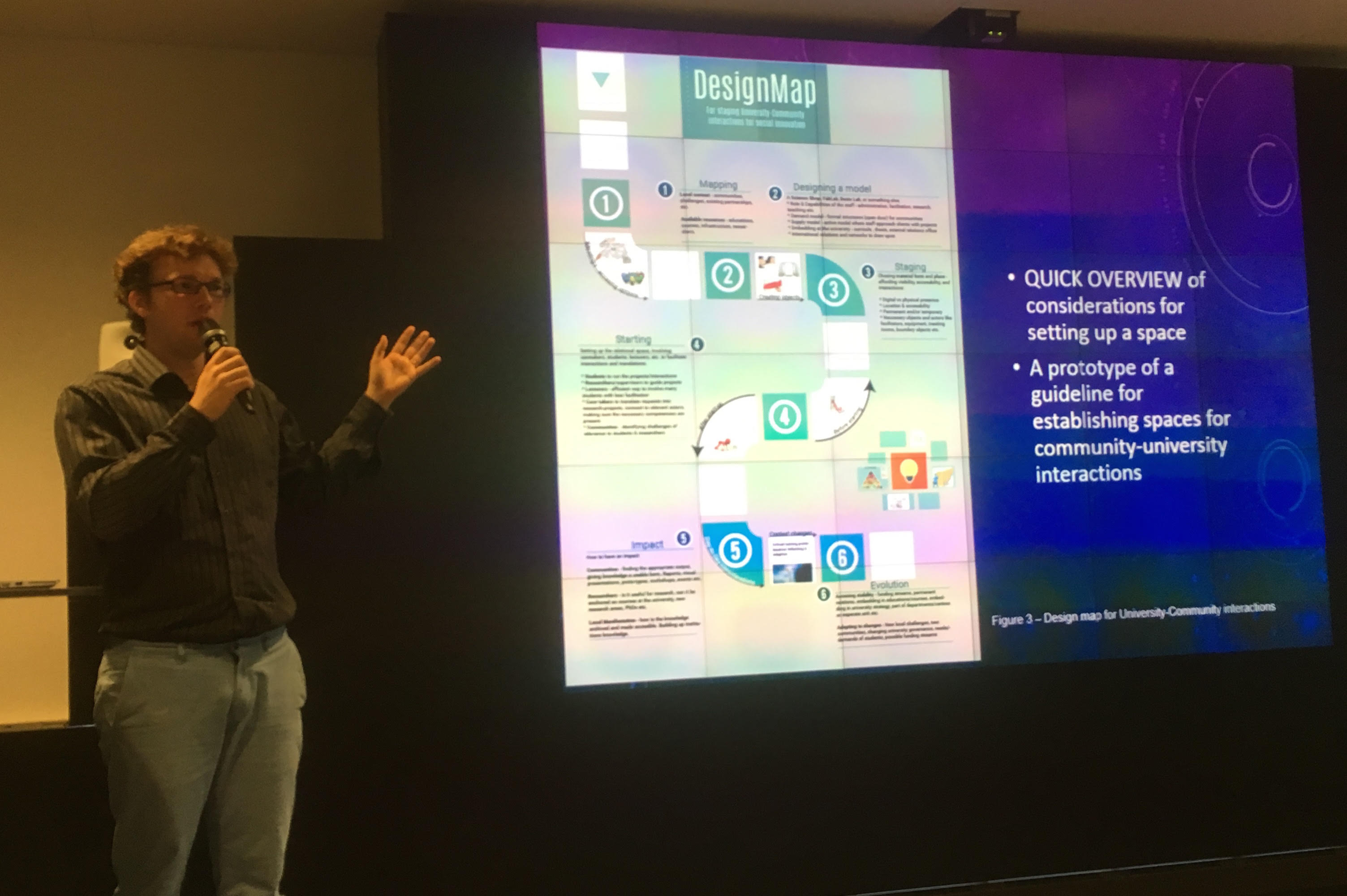
Pictured is Jens Dorland, a doctoral student at Aalborg University
Text: Jens Sjölander
News
Knowledge sharing and exchange of experiences regarding Science Shops
About twenty researchers gathered when Umeå University, in collaboration with Forum for Social Innovation Sweden a discussion on Science Shops and social innovation—a way to strengthen collaboration between civil society organizations and the research community.
Published: