

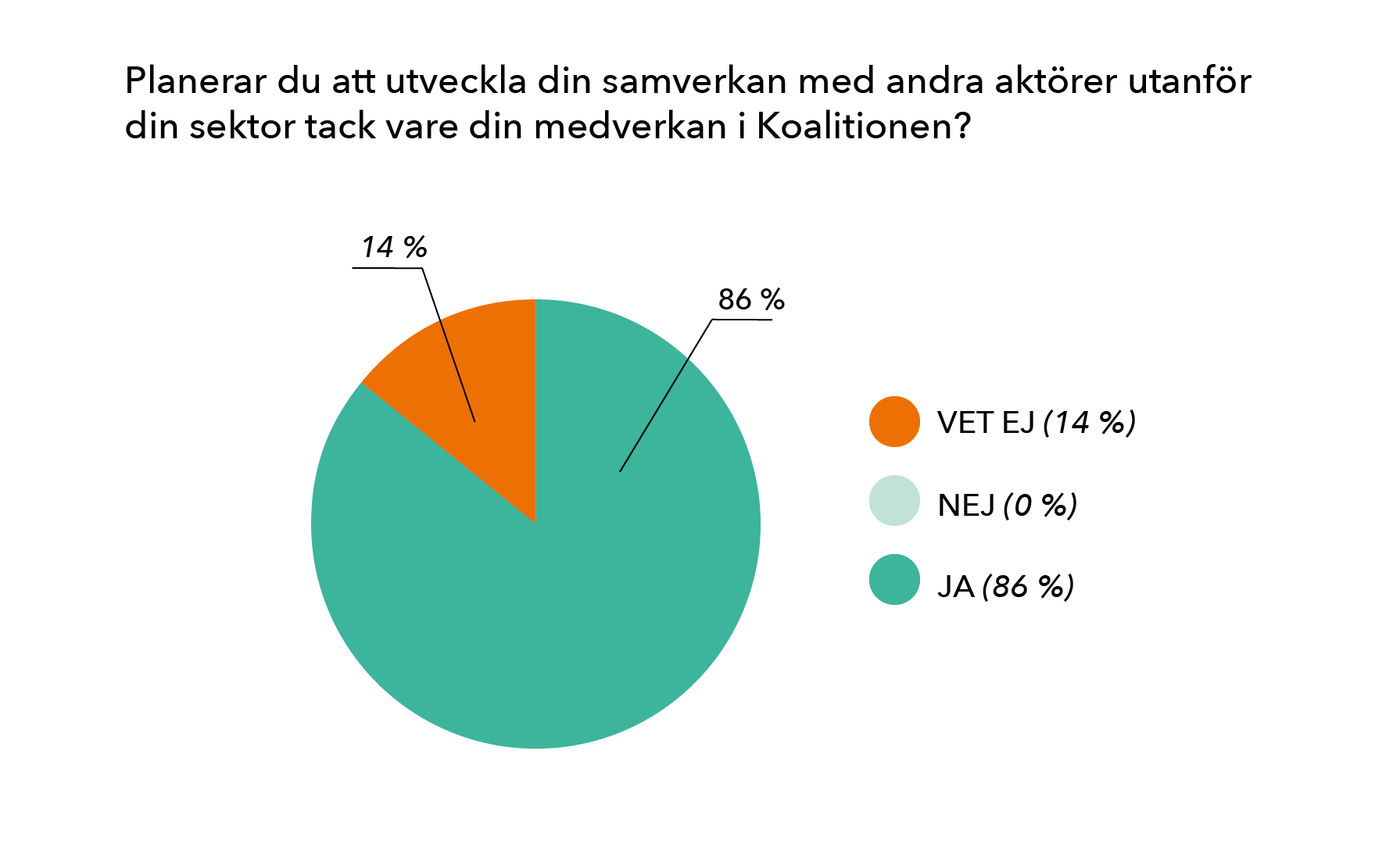
The Coalition for Equal and Comprehensive Education has compiled a list of proposed activities. A clear majority of the organizations plan to strengthen their collaboration with other stakeholders and will continue to prioritize efforts to help children and young people succeed in school.
This spring, Forum for Social Innovation Sweden Malmö University and the Skåne County Administrative Board formed a coalition of 24 stakeholders from all sectors of society to join forces in addressing the question: How can we all contribute to a more equitable and comprehensive school experience?
The Coalition is a digital meeting model designed to facilitate knowledge sharing across sectors, Forum for Social Innovation Sweden . Its purpose is to bring together stakeholders working on a specific societal challenge. The goal is to foster understanding, share knowledge, and enable innovative collaboration.
Johanna Björnheimer, program coordinator at Trans- och Tjejjouren in Malmö, believes that the Coalition has lowered the barriers to knowledge sharing and collaboration:
– The coalition has provided us with contacts and insights into other organizations and initiatives. It’s important to us to be able to put a face to the people we refer to, for example.
Participation in the coalition has led to several proposals for activities and ideas that could help ensure an equitable and comprehensive education:
- Start parent groups – to support parents in their role as parents at school and with their children as students.
- Create a parent portal that could provide information on homework, how the school operates, what grades and assessments mean, and more.
- Reading can be encouraged in connection with other leisure activities, such as by reading in the locker room.
- Training programs designed to highlight gender differences and promote gender equality.
- Working to ensure there are more supportive adults in children’s lives.
- Workshops on how we can combat a culture that discourages studying.
- Develop a structured approach to ensure that children and young people are involved in shaping the activities that affect them.
For the County Administrative Board, the choice of societal challenge was a no-brainer.
“We are currently working to increase equality in the county, with a focus on the conditions in which children and young people grow up. We see that the same protective factors are effective in countering a range of issues, such as poor health, crime, substance abuse, exposure to violence, and more.” One of these important protective factors is a safe and complete school experience,” says Martina Skrak, Gender Equality Strategist at the Skåne County Administrative Board.
The focus has been on organizations outside the school system. Ensuring a safe and fulfilling school experience is an issue that affects more than just the school, and collaboration among various community stakeholders strengthens our efforts. Schools already have many responsibilities today, and there are benefits to having more stakeholders involved in other areas as well.
Anna Singhateh, project manager and coordinator at Pedagogisk inspiration Malmö in the City of Malmö, and Teresa Tomašević, assistant professor at Malmö University, are participating in the Coalition. They work with Muvah—Malmö Youth’s Path to Work through Higher Education, a knowledge alliance between the City of Malmö and Malmö University that aims, among other things, to map and understand young people’s paths through the education system and on to working life.
– The coalition’s mission is very closely aligned with Muvah’s work, and it has been extremely valuable for us to meet other organizations striving toward the same goals. It has been particularly interesting to meet with stakeholders who do not have formal responsibility for ensuring that more students achieve their educational goals. This has given us additional perspectives in our work. We see strength in this diversity of organizational forms because equitable and comprehensive schooling is an issue that concerns society as a whole, not just the education sector,” say Teresa Tomašević and Anna Singhateh.
Some participants had already scheduled meetings to initiate collaboration during the final session. A total of 93 percent of the participants stated that they plan to develop collaborations with one of the other Coalition participants.
“We’re trying to complement a traditional industry with digital platforms, which is why insights and networks are extremely important to us. Participating in the Coalition has given us exactly that, and we plan to initiate collaborations with other participants,” says Cem Celepli, CEO of Snaptive.
On October 15, there will be a reunion for the Coalition participants, where they will have the opportunity to share what has happened since the last meeting.
Fact: How the coalition was perceived
The coalition participants met on four occasions, and at the final meeting, 86% stated that their organizations would definitely prioritize efforts to ensure a more equitable and comprehensive school experience going forward, while the remaining 14% said they would need to advocate for this internally. Some participants scheduled meetings to initiate collaboration as early as the final meeting, and a total of 93% stated that they plan to develop collaboration with one of the other coalition participants.
100% of participants believe they have expanded their professional network, and participation in the Coalition has also fostered a willingness to collaborate across sectoral boundaries: 86% plan to expand their collaboration with other stakeholders outside their own sector as a result of their participation in the Coalition.
Would you like to learn more or get in touch with the coalition?
If you would like to share your knowledge with the Coalition participants at the reunion, please feel free to contact Martina Skrak at the Skåne County Administrative Board or Gloria-Karin López at Forum for Social Innovation Sweden Malmö University.