
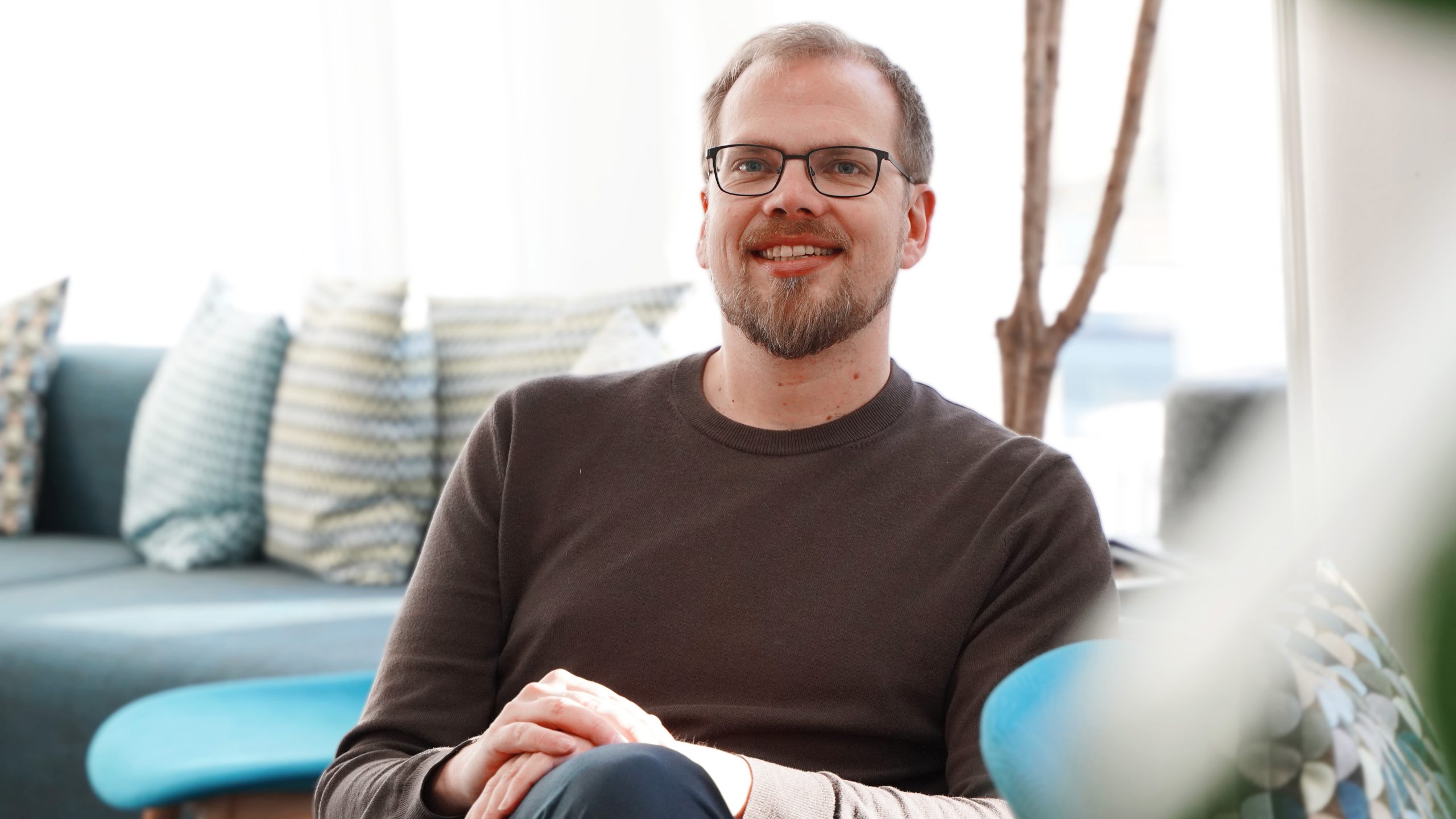
Joel Veborg is the new project manager at Forum for Social Innovation Sweden Malmö University. Together with researchers, he will work to facilitate the co-creation of innovative solutions to societal challenges by establishing a Centre for City Futures in Malmö.
“We need to get better at working together, and we need a space in the gaps—between organizations, departments, assignments, and mandates. There, we can build collaboration based on shared needs, goals, and outcomes, working from the perspective of societal needs with a focus on the big picture and the benefits for residents and society,” says Joel Veborg.
Joel Veborg thrives in the space in between. But operating outside or between existing systems and structures, as well as conventional organizational logic and norms, is demanding and something that both individuals and groups need to practice. It is often a lonely endeavor, and conflicts of interest and power imbalances can easily arise.
Employees, management, and organizations need support
The general capacity and support for collaboration are not particularly strong or well-developed among organizations across various sectors. To achieve the kind of collaboration that brings about systemic change, we need individuals who can thrive in environments lacking established work methods, established structures, fixed budgets, and clear goals. We also need an organization, leadership, and governance that can support these individuals.
“Collaboration often involves negotiations and compromises rather than innovation. This can be counteracted. But that requires individuals who are capable of navigating the gray areas—who have the skills to handle complex and tangled situations. This is where employees and management need support and coaching,” says Joel Veborg.
Collaboration for Sustainable and Green Cities
At Forum for Social Innovation Sweden at Malmö University, Joel will work on the EU-funded transnational project UNIC, alongside Professor Per-Anders Hillgren, Sara Bjärstorp, Executive Director of Forum for Social Innovation Sweden a group of other colleagues at Malmö University. Ten cities facing similar and overlapping challenges will create opportunities for collaboration across seven thematic areas. Malmö University is responsible for the “Sustainability and Green Cities” initiative. Joel will also work on the Interreg project RESIST, which aims to explore and strengthen regional organization of social and ecological innovation and support for social innovation in the countries of the Baltic Sea region.
Joel Veborg most recently comes from Sensus, where he worked as a process leader focused on exploring and developing educational expertise. Among other things, he participated in the development of the “Sustainable Helsingborg” collaboration platform and authored the “Playbook”—a publication that outlines some of the lessons learned, preferred models, working methods, and work processes for the platform. Before working at Sensus, Joel worked for Save the Children. He first became involved with the organization as a volunteer while he was a student and helped start the organization’s largest local chapter in Sweden. Joel was later hired by Save the Children. In 2018, he was part of the team when Save the Children, together with the City of Malmö and others, carried out the pilot project “Forward Malmö,” a platform for collaboration and system innovation. One prototype within the platform was “I Am Malmö,” which the City of Malmö, Tillsammans i förening, and Sensus developed in 2019 using the Sensemaker tool—an ethnographic method where stories are collected to foster understanding of complex challenges, act on large amounts of data, and build resilience, developed by The Cynefin Company.
Numerous collaborations with researchers
Although Joel Veborg has previously always worked in the nonprofit sector, he has maintained close ties with academia over the years and collaborated with many researchers at Malmö University. To name a few examples: Margareta Rämgård with Jämlik hälsa i Lindängen, Jonas Alwall and Anna-Karin Ivert with Kraftsamling Herrgården, Per-Anders Hillgren, Ann Light, Anna Seravalli, Tapio Salonen, Helena Stavreski, Erica Righard, Caroline Wigren-Kristoferson, and Kristian Stålne. He has also collaborated extensively with project manager Jens Sjölander. Joel is also familiar with Forum for Social Innovation Sweden previous Forum for Social Innovation Sweden and has, among other things, attended the Social Innovation Summit
“It feels just right to start working here,” he says.
Fun facts about Joel Veborg
Born and raised in Oxie.
Now lives near Gyllins Trädgård, in Toftanäs, Husie.
The longest continuous period Joel has spent away from Malmö was two weeks, during a trip to Mallorca in 1990.
Studied at Malmö University, first International Relations, then Peace and Conflict Studies and Project Management.
Plays guitar and played in the punk band Lowcut.
Has ridden a skateboard.
Has a son and two cats.
Want to learn more?
Learn more about UNIC https://unic.eu/en/
Learn more about RESIST at https://interreg-baltic.eu/project/resist/
Learn more about Sensus https://www.sensus.se/
Learn more about Sustainable Helsingborg at https://hallbarthelsingborg.se/
Learn more about Playbook at https://hallbarthelsingborg.se/wp-content/uploads/2023/06/Playbook-Hallbart-Helsingborg-2b.pdf
Text: Lotta Orban
Photo: Kajsa Kidman