
Who are you?
My name is Maxim Vlasov. I like to describe myself as both a researcher and a practitioner. My main interest is humanity’s relationship with the rest of nature and its significance for our collective survival in an era of ecological collapse and other crises. As an academic, I divide my time between the School of Business and Economics at Umeå University—where I earned my Ph.D. with a dissertation on the New Green Wave and have worked as a senior lecturer ever since—and the Center for Nature Interpretation at SLU, where I began working as a researcher at the start of the year. But my research is closely intertwined with practical work, as I am actively involved as a nature guide and teacher of survival skills, nature connection, and outdoor living—not least in a year-long folk high school course called “Naturliv.”
How does social innovation relate to your research?
My relationship with the concept began when I studied people who consciously choose to downsize, leave their city lives and office jobs, and move to the countryside to become self-sufficient. Many also start small-scale businesses focused on growing, producing, and processing food. I saw that their choices and actions were of great significance for a sustainable societal transition, but this approach differed from the technological solutions that otherwise dominate politics and public discourse.
Instead, the people I studied offered alternative values and ways of living and organizing food systems that may be less dependent on fossil fuels and economic growth.
These kinds of social innovations often originate from grassroots movements and lack the same resources and funding—which is why they need more attention and support. This is something I also often discuss with my economics students when I teach courses on social entrepreneurship and social innovation.
What does social innovation mean to you today?
For me, social innovation is about addressing ecological collapse for what it fundamentally is: a relational crisis, characterized by the separation between humans and the rest of nature. When nature is viewed as a resource, relationships are reduced to extractivism, destruction, and a one-sided focus on economic growth. Much of today’s innovation work is directed toward technical solutions that address symptoms rather than the underlying causes. Consider, for example, the so-called “green energy transition,” which not only requires immense amounts of electricity and metals but also threatens ecosystems, local communities, and the rights of the Sámi people.
Much of today's innovation efforts are focused on technical solutions that address symptoms rather than the underlying causes.
Social innovation, on the other hand, means redefining our relationship with nature—acknowledging that we are not separate from it but part of an ecological community. This requires different kinds of solutions that help us reduce our consumption and engage in a deeper reevaluation of what we mean by a good life and how we organize our local communities, rather than relying on more technology.
A brief overview of current research?
I am currently working on two research projects, both of which focus on outdoor recreation, environmental humanities, and practice-based research.
The first project is funded by Formas and is called “Surviving with more-than-human kin.” It focuses on developing the practice of teaching and guiding people in traditional survival skills inspired by our long history as hunter-gatherers. This might involve starting a fire using friction, learning about edible and medicinal plants, or creating useful items from what you find in nature. I’m interested in the ethical, philosophical, and pedagogical aspects of this, as well as whether and how this knowledge can strengthen our connection to nature and help us navigate through crises. One example relevant to social innovation is my collaboration with Rewilding Sweden to develop a new method for bringing people out into nature, where they can actively participate in the manual restoration of waterways and forests while learning forgotten knowledge and skills for living in nature, as well as how to live as a group in the forest and cooperate to meet their basic needs. It could simply be a model for regenerative outdoor education and tourism.
The second project, “Ecological Pilgrimage,” is a major Nordic collaboration funded by Biodiversa+ in which we explore the role that hiking—or walking as a practice—can play in an era of climate crisis, species loss, and existential uncertainty. There is often an expectation that outdoor recreation and spending time in nature will, in and of itself, strengthen our relationship with nature. But contemporary outdoor recreation has also become unsustainable, characterized by travel, wear and tear on the landscape, and the consumption of equipment. Inspired by the historically transformative power of pilgrimages, but without reproducing their religious form, we play with “pilgrimage” as a concept and intervention: what kind of existential journey is required in these times? Through a Nordic collaboration, walking interventions are being carried out at various locations in Sweden, Finland, Norway, and Iceland, where walking is explored as a relational practice to renegotiate humanity’s place within a more-than-human context.
What do you think is the most important issue today when it comes to social innovation?
One of the most important issues facing social innovation today is its often unspoken anthropocentrism. Social innovation tends to focus on human needs and so-called social problems, while ecological crises are largely left to technological innovation and the natural sciences. This risks perpetuating the division between the social and the ecological, between humans and nature. A crucial challenge is therefore to redefine what we mean by the social—to include non-human actors as well and to recognize that human well-being depends on living relationships with non-human worlds. Social innovation, then, is about rethinking collective well-being in relational terms, rather than merely optimizing human systems.
Who would you like to pass the baton to, and why?
I’m passing the baton to Malin Lindberg because her research highlights the perspective of civil society and strengthens its role in driving the transition toward a sustainable and more equitable society, particularly in northern Sweden.
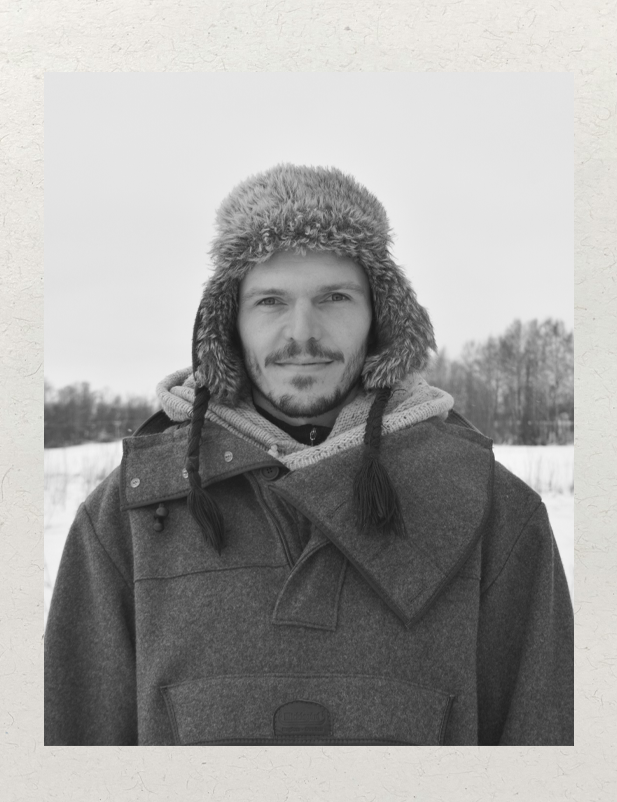
About Maxim Vlasov
Maxim Vlasov is an associate professor of entrepreneurship at the School of Business and Economics, Umeå University, and a researcher at the Center for Nature Interpretation at the Swedish University of Agricultural Sciences.