
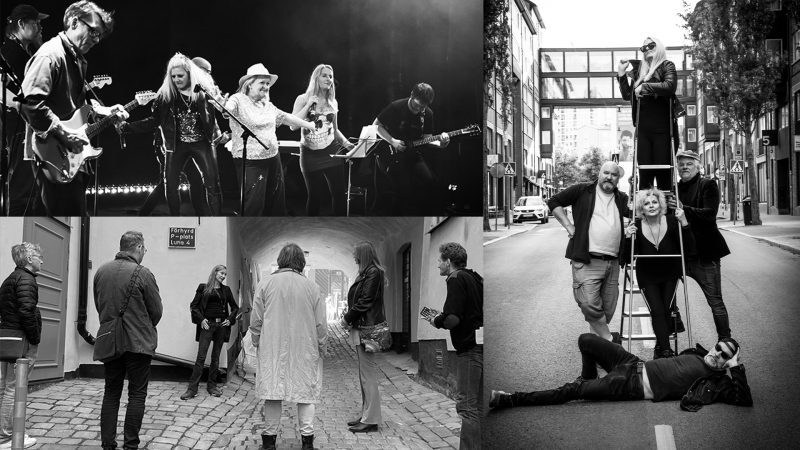
Street Minds is a nonprofit organization dedicated to improving the situation for the more than 1,200 Stockholm residents living in homelessness and to raising public awareness on issues related to homelessness. Street Minds was primarily developed through a project led by Coompanion Stockholm with funding from the General Inheritance Fund from 2018 to 2022. The social innovation lies in the fact that people experiencing homelessness, through Street Minds, develop and offer products and services in the street environment themselves. This provides opportunities for meaningful employment that can change their living conditions—such as increased empowerment through a degree of self-sufficiency, strengthened self-confidence, and social community.
What does social innovation mean?
The social innovation behind Street Minds lies in the fact that homeless individuals develop and offer a range of services and products that can be produced and sold in a street setting. A representative of Street Minds notes that this form of employment means a great deal to many people experiencing homelessness and has helped improve their living conditions. Such as the opportunity for some self-sufficiency, increased self-confidence, and a sense of community.
Examples of these activities include city walks—where guides who have experienced homelessness share their personal stories and perspectives on Stockholm—and the rock band Dom Fläckfria, which performs music with original lyrics inspired by the harsh realities of life on the streets. Other examples include urban gardening (both for personal use and for sale) and Radio Gatan, where homeless people meet “ordinary Swedes” to talk and offer advice based on their life experiences.
What is the societal challenge?
Street Minds addresses the social challenge posed by the fact that many people are experiencing homelessness and social vulnerability. According to the National Board of Health and Welfare’s latest survey from 2024 (see Survey of Homelessness 2023), 1,261 people were experiencing acute homelessness in Stockholm. According to the City Mission’s 2024 homelessness report, there is also a significant underreporting of cases. Many abuse alcohol or drugs, lack meaningful employment, and mental health issues are widespread, according to Street Minds representatives. At the same time, people living in homelessness also possess a wealth of life experience and skills.
What does the vision for social change look like?
Street Minds’ vision is to create a society where everyone, regardless of background or life circumstances, has the opportunity to participate and contribute. By providing employment opportunities for people experiencing homelessness, their living conditions can be improved, leading to greater self-sufficiency, increased self-confidence, and a sense of social belonging.
Which partners and resources have been mobilised?
Street Minds collaborates with several organizations that have experience and a commitment to supporting people in vulnerable situations. In the project funded by the Inheritance Fund—which made it possible to establish the organization—Coompanion Stockholm served as the project owner, participated in the steering committee, and provided project support. Street Minds also received guidance from Convictus, a nonprofit organization that supports people with substance use disorders in Stockholm.
Their current partners are primarily the City of Stockholm, with which they have an IOP agreement. Today, the City of Stockholm’s approach to homelessness focuses primarily on social housing rather than treatment centers, which means that homeless individuals are provided with apartments in standard rental buildings. In this housing, however, many risk becoming lonely. The IOP agreement means that Street Minds is paid for its activities that can reduce loneliness—such as urban gardening and cooking groups.
Street Minds also collaborates with the magazine Socialpolitik, where homeless individuals are paid—through a project funded by the Inheritance Fund—to publish reviews—such as book releases and concerts—from their own perspective. Another collaboration is with Convictus, where homeless individuals create an Advent calendar featuring photos of homeless people and their own words of wisdom, inspired by a similar project in Bristol.
They also collaborate with an event company that helps with bookings for the city walks; students have assisted with marketing; and several well-known artists have performed pro bono with the band Dom Fläckfria. For example, Lisa Nilsson, the punk band KSMB, and Kikki Danielsson. DomFläckfria performs regularly at various venues, such as churches, folk parks, rock clubs, and conferences organized by social services. Their most recent performance was at a major event for social services at the Oscar Theater in Stockholm.
What was the development and testing process like?
The journey that led to today’s Street Minds was built on several steps taken over time. The founders worked at an emergency shelter in Stockholm and observed that all the homeless people there were unemployed, whereas homeless people in many other countries are employed, despite problems with alcohol and drugs. Several of the founders also have extensive experience—gained over the past 15 years—working with people far removed from the labor market at the social cooperative Macken in Växjö.
The organizers jointly submitted an application to the Inheritance Fund and were able to develop the program between 2018 and 2022. The project began with a study of entrepreneurship and job creation initiatives for the target group in other countries. Several of these have since been introduced in Stockholm, such as city walks in Copenhagen, London, and Berlin; in Manchester, homeless people sang in their own rock band and wrote their own lyrics. An idea was brought over from Croatia where homeless people—with all their life experience—help “ordinary Swedes” with life issues. An idea for urban gardening was brought over from London. All of these, plus a few others, have now become established programs.
How have these innovative solutions been implemented and disseminated?
Through the project funded by the Inheritance Fund, a social cooperative was established in the form of an economic association called Street Business, which was later converted into the nonprofit association Street Minds. The cooperative structure remains in place, with members who are both participants and co-owners. The board consists of a mix of both homeless individuals (a majority) and non-homeless individuals. There is a staff of four employees working part-time with approximately 50 participants who are experiencing homelessness.
Street Minds is not currently expanding to other locations, but if there is interest, they would be happy to take on a mentoring role, according to the spokesperson.
In its role as a think tank, Street Mind advocates for and identifies measures that create better conditions for Stockholm residents facing economic and social vulnerability. It draws inspiration from other countries and highlights innovative solutions regarding alternative forms of work and housing for the municipality and the region.
In recent years, Street Minds’ advocacy efforts have focused on getting Sweden to introduce a social exemption card. In Denmark, people who have had difficult lives and have not worked for a very long time are entitled to earn 40,000 kronor per year before their income begins to be offset against their welfare benefits. Among other things, Street Minds has succeeded in securing a hearing in the Riksdag, and opinion pieces have been published in several daily newspapers.
What value has been created?
Street Minds creates value by providing employment and a sense of community for people experiencing homelessness and social vulnerability. It has helped improve the living conditions of homeless people and increase their inclusion and empowerment. Street Minds representatives state that homeless individuals can use their skills, they are seen, gain increased self-confidence, do something meaningful, and to some extent also earn their own living. In many cases, life has changed significantly for the better through participation in Street Minds, according to them.