
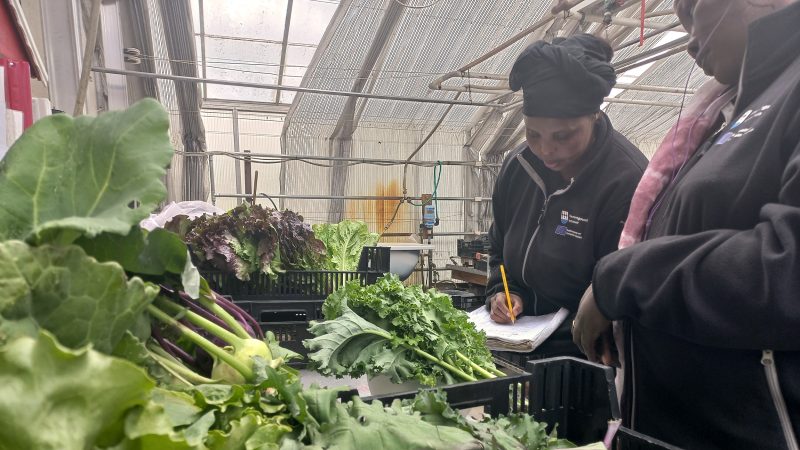
Odla svenska is an ESF-funded project run in collaboration with several departments within the municipality of Stenungsund. The project’s primary aim is to improve the language skills of unemployed individuals with an immigrant background who have little or no formal education. Language training takes place through practical activities such as gardening and textile crafts, combining theory and practice in an inclusive and supportive environment. The second part of the project is to contribute to the municipality’s circular transition efforts by using homegrown vegetables in municipal operations and recycled textiles to sew meal scarves for the municipality’s senior care facilities. The social innovation thus lies in a novel combination of language training and circular transition.
What is social innovation?
The socially innovative aspect of "Odla svenska" lies in its innovative combination of language training—supported by SFI teachers, an agricultural educator, and a labor market consultant—and the products developed through the language training program, which contribute to the municipality’s circular transition.
The products consist of textile crafts and homegrown vegetables. The textiles are collected from the municipality’s recycling center, and the participants then sew them into meal scarves for seniors at one of the municipality’s nursing homes—where the residents want to switch from their regular bibs. Vegetables are grown at Åbacka Trädgård, a gardening and crafts program run by the municipality’s Individual and Family Care department. The vegetables are then used in some of the municipality’s cafés.
The participants have limited language skills, little formal education, and minimal work experience from formal employment, but they often have extensive practical experience and a wealth of knowledge from, for example, domestic work or agriculture, and thus possess highly valuable expertise. However, they often have little experience with classroom instruction; by more clearly linking theory to practical work—which they are accustomed to—the conditions for connecting to their experiences and learning more Swedish are improved.
"Odla svenska" is thus both a targeted labor market initiative that employs an innovative approach to teaching Swedish and an innovative way to contribute to the circular transition.
What is the societal challenge?
Odla svenska addresses two societal challenges. One of them is the difficulty people with immigrant backgrounds and low levels of education and language proficiency face in entering the labor market. Several of the participants have previously attended SFI, but traditional lecture-style teaching has often proven ineffective there. The more practically oriented teaching approach with instructors creates different conditions. The second challenge is the major climate and environmental problems facing society. Through the project’s reuse of textiles and cultivation of its own vegetables, the climate and environmental impact is reduced.
What does the vision for social change look like?
The vision for Odla svenska is to create an inclusive and supportive learning environment where participants can improve their language skills—in a way that suits their experience and learning style—and gain new tools to access the job market, while also addressing climate and environmental challenges. As a result, the project has both social and ecological goals.
Which partners and resources have been mobilised?
The project collaborates with several departments within the Municipality of Stenungsund—such as the Labor Market Department, Adult Education, Daily Activities, Individual and Family Care, the Waste Management Department, and the Tallåsen Senior Living Facility. Examples of external partners include the Gothenburg Region’s “Resource-Smart Municipality” project, Egnahemsfabriken on Tjörn, and Billströmska Folk High School.
The project has strategically involved both policymakers and civil servants in the work. External project funding from the ESF has facilitated implementation, and the project manager’s prior experience with both SFI and the labor market unit has contributed to the ongoing efforts to build support and implement the project.
The target group has been involved in the development of the program itself in several ways. During the initial phase, in-depth interviews were conducted with SFI students, which served as the basis for the project idea itself; moreover, participants have had a say in the day-to-day work throughout the project. This is because the practical aspects of the program are continuously adapted to the participants’ needs, preferences, and knowledge.
What does the development and testing process look like?
The idea for Odla svenska emerged from the project manager’s identification of two challenges: the slow pace of progress among SFI students with limited educational backgrounds, and the difficulty of finding internships that foster language development. To address these needs, an idea began to take shape: to create a meaningful, practical learning environment that leverages the participants’ knowledge and experiences.
Over time, the idea also emerged to combine this with a production activity—in this case, vegetable farming and textile recycling—that contributes to the circular transition within the municipality. This has proven to have many benefits, as it instills a sense of pride in the participants’ work and naturally brings them into contact with many different municipal operations.
The project has had eight participants over the course of a year, and the teaching methods have been continuously refined. The basic principle is based on a close connection between theoretical components and practical work, which makes the language more understandable, relevant, and meaningful for the participants. The practical work also creates natural opportunities for language practice. Unlike traditional SFI instruction, the focus is primarily on oral language proficiency.
Since the project staff consists of employees from the Labor Market Unit, SFI, and Social Services, a collaborative effort has emerged, which is an asset for both the project and the participants. In addition to language development, common approaches are also being developed to support participants in other areas that may hinder their transition into the workforce.
Production within the project is also being developed on an ongoing basis. Crops are grown using organic methods and planned according to the season and local conditions, and during the project’s second year, the harvest has increased significantly compared to the first year. In the textile sector, participants, together with a textile educator, have developed designs for meal scarves in consultation with staff in elder care. The design and materials have been adjusted based on the needs and feedback from the facility.
How have these innovative solutions been implemented and disseminated?
Odla svenska will be established in the municipality of Stenungsund (within the relevant departments) as a long-term solution to improve the language skills of unemployed individuals with an immigrant background who have little or no education, and to contribute to the circular transition. The project is working to expand the initiative to more locations and target groups to increase its impact. Among other things, they have applied for funding from the County Administrative Board to be able to expand the concept to other municipalities.
What value has been created?
According to the project manager, the project has provided participants with several key benefits. They have seen clear improvements in their language skills, have gained a sense of fulfillment from performing meaningful tasks where their work is actually put to use, and have seen their self-confidence grow. It is unclear at this time how many have actually moved on to further education or employment, but a valuable foundation has been laid through several milestones.
In addition, they have promoted the municipality’s circular transition efforts by reusing textiles and growing local produce. During the project’s first year, 500 kg of vegetables were delivered, and a total of 520 meal scarves were sewn.